Jurassic Park Ripple Effect: The Ripple Heard Around the World and Spielberg’s Practical Magic
Introduction: A Tremor in Time
Picture yourself in a darkened theater, summer of 1993. The Jurassic Park logo fades in, and your pulse quickens. Before the T-Rex roars into view, a subtle omen steals your breath: ripples dance across a cup of water, each wave a heartbeat signaling the approach of something massive, something alive. That moment wasn’t just a special effect—it was a love letter to practical filmmaking, penned by Steven Spielberg and his ingenious crew. For behind-the-scenes movie lovers, it’s a reminder of why we fell in love with cinema: the alchemy of creativity, grit, and real-world magic.

The ripple wasn’t born in a computer—it came from a guitar string, a Styrofoam cup, and the relentless problem-solving of special effects supervisor Michael Lantieri. In an era when CGI was still a clunky toddler, this low-tech solution didn’t just solve a problem; it became one of cinema’s most iconic movie FX moments.
This deep dive explores how that trembling water redefined practical effects in movies, why it still resonates with FX enthusiasts, and why the simplest tools often create the most unforgettable stories.
What You’ll Discover:
• The challenge of capturing a T-Rex’s presence without CGI.
• How Michael Lantieri’s guitar-string trick became a legend.
• Why practical effects remain the heart of cinematic storytelling.
• A nostalgic reflection on Jurassic Park’s enduring craft.
Let’s step onto the set and relive the magic.
The CGI Conundrum: When Pixels Fell Short
In 1993, CGI was the shiny new toy of filmmaking, dazzling audiences in films like Terminator 2. But for Jurassic Park, Spielberg wanted more than visuals—he wanted audiences to feel the T-Rex’s approach, to sense its weight and power before it even appeared. The problem? Early digital water simulations looked sterile, like a screensaver—too smooth, too predictable. They lacked the chaotic, organic pulse of real water disturbed by a primal force.
Spielberg’s team faced a daunting task: create a ripple effect that was precise yet unpredictable, synchronized with the T-Rex’s unseen footsteps. Digital tools couldn’t capture the raw physics of fluid dynamics—every wave needed to feel alive, reacting to an invisible beast.
Enter Michael Lantieri, a practical effects maestro whose work on Back to the Future and Who Framed Roger Rabbit proved he thrived under pressure. His challenge was clear: find a real-world solution to make water tremble on cue, as if a 40-foot predator were stalking nearby.
Lantieri’s Stroke of Genius
Lantieri’s solution was as simple as it was brilliant: a guitar string, a cup of water, and a spark of ingenuity. While testing ideas, he noticed ripples forming in a cup near his guitar as he plucked a low note. That happy accident became the blueprint for one of cinema’s most memorable practical FX moments.
How It Worked:
1. The Setup: A guitar string was stretched taut beneath a Styrofoam cup filled with water, placed on a surface that could carry vibrations.
2. The Trigger: A low-frequency oscillator sent a deep, rumbling pulse through the string, mimicking the T-Rex’s earth-shaking steps.
3. The Ripple: The string’s vibrations transferred energy to the cup, creating concentric waves that danced with eerie precision.

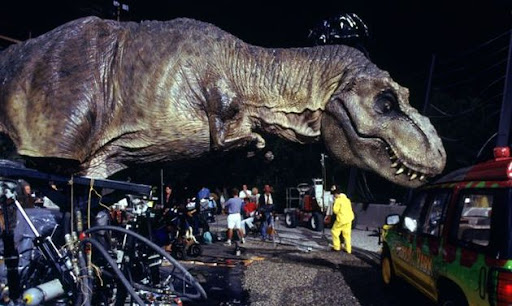
This wasn’t just a trick—it was a masterclass in control. Lantieri could tweak the frequency and amplitude to match the T-Rex’s pacing, syncing the ripples with Stan Winston’s animatronic dinosaur and John Williams’ booming score. The result? A tactile, visceral moment that made audiences lean forward, hearts pounding, as if they were in the Jeep with Alan Grant.
Behind-the-Scenes Magic: Lantieri’s discovery wasn’t planned—it was born from experimentation, the kind of happy accident that defines Spielberg’s behind-the-scenes genius. It’s a reminder that the best ideas often come from playing, tinkering, and trusting your instincts.

The Enduring Power of Practical Effects
The Jurassic Park ripple effect is more than a clever workaround—it’s a testament to why practical effects in movies remain the soul of filmmaking, even in a CGI-saturated world. Here’s why they still captivate us:
1. Tangible Realism
Practical effects live in the real world, interacting with light, gravity, and physics in ways CGI struggles to replicate. The Jurassic Park ripple feels alive because it is—real water, real vibrations, real stakes. Compare it to:
• The liquid-metal T-1000 in Terminator 2, created with mercury and mirrors.
• The spinning hallway in Inception, a massive rotating set that grounded a dreamlike scene.
• Yoda’s puppetry in The Empire Strikes Back, whose expressive face still outshines digital versions.
2. Creativity Under Constraints
Practical effects thrive on limitations. When George Lucas needed a starfield for Star Wars, he punched holes in cardboard and backlit it. When Ridley Scott wanted Alien’s chestburster, he used hydraulics and real gore. Lantieri’s guitar string is part of this lineage—proof that ingenuity trumps budget.
3. Emotional Resonance
Audiences connect with what’s real. The animatronic T-Rex terrified because it shared physical space with the actors. The practical explosions in Mad Max: Fury Road thrilled because they were actual cars flipping in the desert. That ripple? It’s a shared heartbeat between the audience and the film.
4. Timeless Craft
Practical effects age like fine wine. While early CGI (like The Mummy Returns’ Scorpion King) often feels dated, films like 2001: A Space Odyssey or Blade Runner stun with their in-camera illusions. The ripple still holds up because it’s real, untainted by the march of technology.
The Practical FX of Gremlins Legacy – Bringing the Mogwai to Life
Explore more legendary creature effects in our behind-the-scenes look at Gremlins Legacy’s Practical FX
A Ripple of Inspiration
The Jurassic Park ripple effect isn’t just a technical triumph—it’s a love letter to the craft of filmmaking. It captures the thrill of solving problems with your hands, of turning everyday objects into storytelling tools. For FX enthusiasts, it’s a call to action: embrace the tangible, the messy, the real.
Every ripple in that cup is a reminder of what makes movies magical—not flawless pixels, but the human ingenuity behind them. It’s the late-night brainstorming on set, the crew laughing as they test a ridiculous idea, the moment when a simple string becomes a prehistoric tremor. This is filmmaking at its purest: a blend of art, science, and heart.
DIY Fog and Smoke Effects: Create Eerie Horror & Sci-Fi Atmospheres
Want to build other cinematic effects? Learn how to create eerie sci-fi fog and horror smoke in our DIY Fog and Smoke FX Guide”
Conclusion: The Legacy of a Trembling Cup
Jurassic Park redefined cinema by marrying CGI with practical effects, but its most iconic moment came from a guitar string and a cup of water. That ripple is more than a special effect—it’s a symbol of why we love movies. It’s the spark of discovery, the joy of creation, and the power of practical FX to make us believe in the impossible.
Explore another Spielberg masterpiece: how the melting face effect in Raiders of the Lost Ark became cinematic legend.
The Melting Face of Raiders: How Practical Effects Made Movie History

For behind-the-scenes fans, the ripple is a rallying cry: practical effects aren’t relics; they’re timeless tools that demand creativity and deliver wonder. Next time you watch Jurassic Park, pause at that trembling cup. Feel the weight of the T-Rex, but also the passion of a team that turned a simple idea into cinematic history.
???? Want to Try It Yourself?
Build your own Jurassic Park ripple effect at home for under $20.
How to Recreate Jurassic Park’s Ripple Effect for Under $20: A DIY Movie Magic Guide
Final Thought: What’s your guitar-string moment? The next time you face a creative challenge, look around. The tools for your masterpiece might be simpler—and more powerful—than you ever imagined.